Table of contents
- The fundraisers
- The Bounce Back Loan for D Media
- Social media payments scandal
- Oh, how the mighty fell
Simon Harris is a well-known Internet prankster and “comedian” who used to have an online presence as “Man Behaving Dadly”. He had hundreds of thousands of followers on his personal social media in this guise, primarily on Twitter/X but also on Facebook.
His carefully crafted social media persona interspersed jokes about current topics of the day (and old favourites, like the mouldy banana at the bottom of your kid's lunchbox that you only find at the end of the summer holidays) with social commentary about Brexit, Meghan Markle, and the England women's football team.
These high engagement posts would then typically be followed by a plug for a fundraiser he was running. All these things appear to have worked in a virtuous cycle to increase his profile on social media: more followers, more donations, more media coverage, and so on.
Some might call his strategy “engagement farming”, others characterise it as a legitimate way to “do good”.
Regardless, it all came crashing down for Simon Harris on 10th January 2024. This is because he deleted or deactivated most of his social media. His Twitter account, at @simonharris_mbd? Gone. His Instagram? Gone. His Facebook? Gone.
The catalyst for this sudden action appears to have been because I publicly questioned why he felt the need to set up a fundraiser for victims of the Post Office scandal on 4th January 2024, and then voiced concerns about the transparency of his previous online fundraising and the perils of online fundraising more generally.
I did find it strange at the time that Mr Harris didn't address any of my questions raised about the fundraisers before deleting his Twitter/X account, and has since only provided general statements about the matter—leaving some donators feeling “disgusted” and “angry” at his behaviour, but again that just highlights the many unanswered questions that remain.
Fascinating that Simon Harris / MBD is now raising funds for victims of the Post Office scandal. Why not just direct them to the charity yourself?
— Legal Gengar (@LegalGengar) January 4, 2024
We've noticed that he has a habit of doing that: opening up multiple fundraisers and rarely accounting for where all the money goes.
This was then followed by an investigation into the turnover of one of his recent companies on 7th and 8th January 2024 and how it was able to qualify for a sizeable Bounce Back Loan during the pandemic, only to enter insolvency and be liquidated months later.
How does a company that seemingly focuses on uploading and monetising dashcam footage videos (getting paid per view / with ads on the video, basically - similar to your favourite content creators on YouTube) or possibly distributing shitty NHS videos (like this one:…
— Legal Gengar (@LegalGengar) January 7, 2024
This was followed by the revelation on 9th January 2024 that he was paid almost £500,000 by Essex County Council for social media services during the pandemic.
Something must have gone very badly wrong for @simonharris_mbd to receive £484k of taxpayers money from Essex County Council for performing broadly the same service as @jonmorter, the man who came up with the idea of Facebook-based Essex community groups in the first place, who…
— Legal Gengar (@LegalGengar) January 9, 2024
To be clear: Simon Harris has not committed any crimes and there is no suggestion of any personal wrongdoing in relation to his company because there's no publicly available evidence that he was responsible for, or even knew about, the Bounce Back Loan application and the associated stated turnover.
And, of course, there's nothing illegal about being paid almost £500,000 by a local authority for social media services, even if you do end up keeping £367,000 of that yourself.
Since then, various media organisations have covered the social media payments scandal:
- 11th January 2024, BBC: Essex County Council paid internet prankster Simon Harris £500k
- 12th January 2024, The Times: Cash-strapped council gave comic Simon Harris £500,000 to run Facebook page
- 27th January 2024, BBC: Essex online prankster Simon Harris kept £367k from council contracts
- 13th February 2024, BBC: Simon Harris: Council admits 'lack of controls' over payments
- 16th April 2024, BBC: Oversight of council payments to prankster 'woeful'
- 26th July 2024, BBC: Council's £15k Facebook spend for 189 followers
and by pure coincidence after all this ill-advised spending, Essex County Council would go on to raise council tax by 5% and slash services by £32 million in the financial year 2024-2025:
Ah, here we go. Essex County Council to save £32 million in the next financial year:https://t.co/UK0xPm5I2Y
— Legal Gengar (@LegalGengar) January 9, 2024
And increasing council tax by FIVE PERCENT. With egregious wastes of public money like this, it's no wonder council tax has to rise so much!https://t.co/76MYL9exEa
Now, let's dig into each part.
The fundraisers
Simon Harris has commendably raised a lot of money for good causes. Most recently, he set up a fundraiser to help provide baby formula to parents after a shocking price increase. That raised almost £65,000. He has also raised almost £16,000 for tents for homeless people, £92,000 to support Ukrainian children, and £238,000 to buy a new hovercraft for the RNLI.
Again, there is no question of any wrongdoing regarding any of these fundraisers. Where the fundraiser states it is being organised "on behalf of" the recipient (e.g. the RNLI), the money is sent from GoFundMe's charity arm directly to the recipient and Gift Aid is applied, albeit that it takes longer for the charity to receive the money than if you were to donate to it directly yourself.
It does appear, however, that given the number of fundraisers Mr Harris has set up, and of course the cross-pollination of these fundraisers across all his social media accounts, that in my opinion these weren't really set up wholly charitably, and that Mr Harris benefitted from the exposure with more followers and media exposure as a result.
There is, of course, nothing wrong with that—although some might argue it's a bit morally disingenuous—but I think there is a risk that you can find yourself spread too thinly trying to manage so many different fundraisers.
The baby formula fundraiser
I had concerns over the fundraiser for baby formula. Again, there is no suggestion of personal profit gain or wrongdoing. My concerns covered several things:
- £65,000 is a lot of money for one person to be responsible for, stored in (presumably) a personal bank account which no doubt contributed to stress when people started asking entirely reasonable questions
- At the time, there was no full public accounting for where the money had gone. An estimated £24,000 hadn't been accounted for. Mr Harris has since stated that it has gone towards various independent one-off donations to foodbanks and babybanks, although no receipts or proof was provided
- In relation to online fundraising it highlighted the fact that you simply have to take it on trust that your donation is going where you expect it to, and it's an entirely unregulated area
The “help are own first [sic]” fundraiser
Separately, the outcome of another fundraiser caught my eye. A “help are own first [sic]” fundraiser raised £33,358. Mr Harris later claimed that he had donated it all to Community Agents, an initiative run by The Rural Community Council for Essex, but it has been difficult to determine what ultimately happened to the money.
On the fundraising page, on 26th August 2021, Simon Harris said that some of the funds had been used to purchase a storage container for the Council for Voluntary Service Uttlesford in Essex, although it's not clear how much had been raised by then.
Again, there's no suggestion of any wrongdoing by anyone involved. It's just that there doesn't appear to be any mention of over £30,000 being donated to Community Agents in their accounts for 2021-22 or 2022-23.
In the accounts, there are references to two sets of donations and an Afghan refugee fund that the organisation set up, but both donations fall a long way short of the stated figure of over £30,000.
In accounts for the year ending 2022, the Rural Community Council for Essex received £2,192 in donations and £4,384 in income for the Afghan Refugee Fund which came in the form of a government grant.
In accounts for the year ending 2023, the Rural Community Council for Essex received £2,069 in donations. The Afghan Refugee Fund appears to have been wound down by this point as it doesn't appear in the financial statements.
Community Agents has, as of 1st April 2022, been handed over by the Rural Community Council for Essex to Essex Wellbeing Services, an initiative run by Provide Community Interest Company.
It's possible—albeit unclear—that the money shows up in the accounts for Provide Community Interest Company, potentially as “income” as they don't seem to record any donations—although they pay out a lot in donations to other worthy causes.
Again, there is no suggestion that the money didn't end up where it was meant to, it's just difficult to trace the impact of donating and marry it up to what was actually achieved versus what the donator believed they would be contributing to when they donated, whereas with a direct donation there's more accountability and more of a chance of finding out what your donation actually impacted.
Inefficient fundraising
Separately, GoFundMe confirmed there's a payment processing charge on every donation: 1.9% plus 20p for donations "on behalf of" a charity (i.e. that go directly to them) and 2.9% + 25p for "personal" fundraisers.
Of course, it's likely that direct donations would also incur a processing charge depending on the payment method so GoFundMe isn't unusual here—I suppose the saving grace is that at least for the “on behalf of” fundraisers, the fee would only have been 1.9% + 20p per donation. However, for the baby formula and the “help are own first [sic]” fundraisers, it seems GoFundMe took 2.9% + 25p for each donation.
That is a woefully inefficient method of fundraising, and it's not clear if the recipient would be able to take advantage of Gift Aid given that the donations for those two campaigns would have gone through a middleman (Simon Harris) and then on to the recipient, so it seems possible that the recipients would have missed out on an extra 25% for each eligible donation (Gift Aid rules appear to require that the donation is sent directly to the charity).
The problem with online fundraising
Ultimately these two online fundraisers exposed what I think are two quite serious problems for online fundraising:
- There's no regulation for online fundraisers. There is the Fundraising Regulator but that only regulates charity fundraising where the funds are going to, and are raised on behalf of, a nominated entity. It doesn't cover a random person raising funds online to distribute to a good cause (such as the baby formula fundraiser).
- Donators often have no control, or idea, where their funds are actually going. There's no easy way of finding out, in many cases, what their money was spent on, and whether it had the intended impact.
Indeed, there is a wider cultural problem here: quite often legitimate questions are drowned out by claims that they are “trolls”, or that the people raising this money should be absolved of needing to answer any questions purely for “all the good they do”. It is as if a halo of “goodwill” shields people from being rightly held to account, where online fundraisers are concerned.
It leads me to conclude that people really need to think critically before they donate to yet another online fundraiser. They should be prepared to ask difficult questions, ask for proof of where the donations go, etc. and ultimately walk away if they have any concerns. The best route, at the moment it seems, would be to simply donate to the charity or good cause directly and cut out the middlemen entirely.
The Bounce Back Loan for D Media
Simon Harris was a director of a company called D Media Limited. It was incorporated on 8th March 2019 and liquidated on 15th March 2023. It claimed to be in the business of hosting so-called “dashcam footage” videos on its website and on various social media platforms such as Facebook and YouTube.
Mr Harris was also a contributor to the website. An archived copy of the website indicates it was owned by D Media Limited.
In or around 2020-2021, D Media Limited was able to successfully apply for and receive a Bounce Back Loan (BBL) of £21,000. This was evidenced in the statement of affairs from its winding up on 19th May 2022.
The conditions of a BBL were that you could apply for between £2,000 and up to 25% of your company's actual or estimated turnover (with a maximum limit of £50,000). In this case, as the company was incorporated in 2019, I believe it was permitted to rely on estimated turnover for the upcoming financial year.
£21,000 is 25% of £84,000, which is how I have been able to calculate the turnover that must have been supplied when applying for the BBL originally.
The BBL application process relied mostly on self-certification where directors stated the company met the criteria for the lending scheme and few, if any checks, were carried out by the banks lending the money.
Normally we'd be able to look at the profit and loss account to understand the commercial logic behind applying for a BBL, but D Media Ltd relied on the "small company exemptions" in law to avoid filing that particular account and instead only filed a balance sheet, rendering it impossible to work out how much money it ever actually turned over.
There is no suggestion of any wrongdoing in that—it is completely legitimate to not file the profit and loss accounts; there's currently no legal obligation for them to be filled, provided the relevant criteria is met.
These accounts were the first and only set it ever filed - it was in liquidation by the time the next set were due so it's turnover will never be known.
However, the company does not appear to have been very successful. Exact details of its finances are not available, but I consulted with industry experts about how content creators typically make money. They said that most content creators are paid on views and/or engagement. In this case, given that D Media was in the business of uploading videos, it's likely they were paid based on views. The organic traffic to the website appears to have been quite low. Admittedly, this is just a rough analysis but the analysis indicates it was probably a low-quality website with few hits. Although the figures are from this year, after speaking with marketing and SEO experts, it seems unlikely that the site would have generated enough ad traffic during the relevant time period to accrue a significant income, especially with an ambitious turnover figure of £84,000.
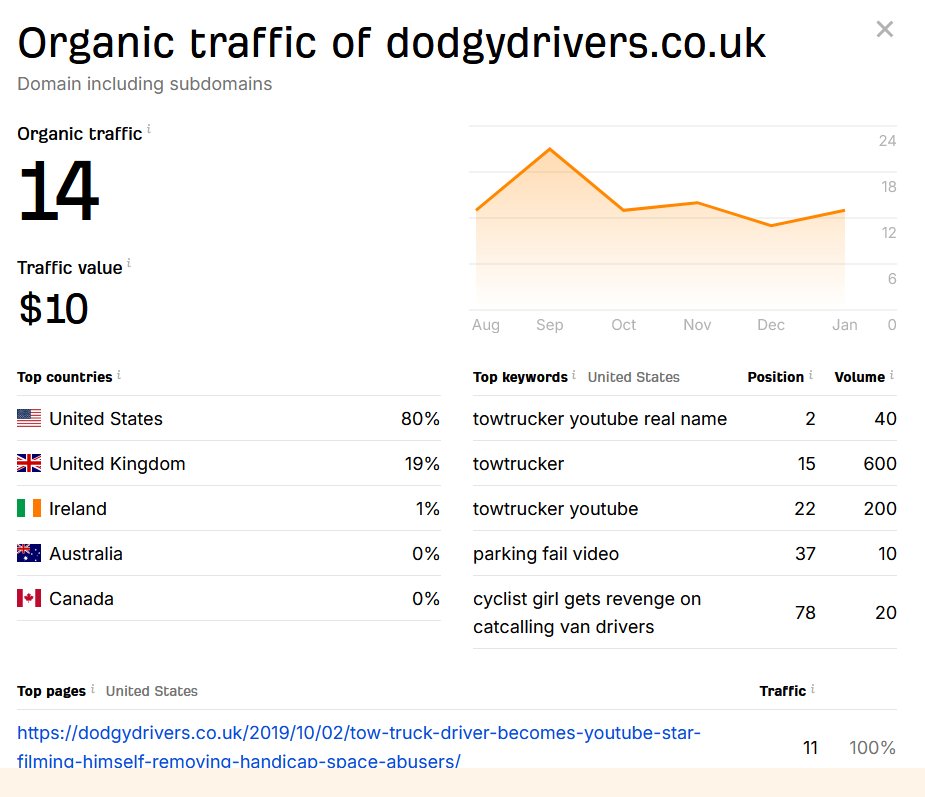
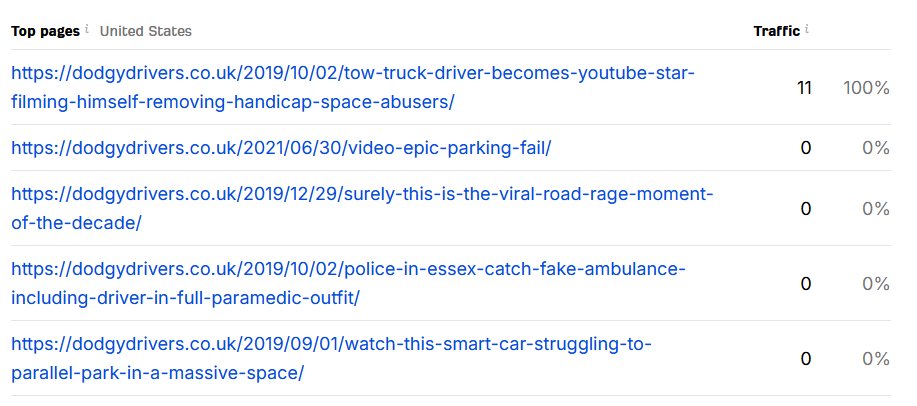
The website had adverts running on it through Google Adsense. According to an industry expert I spoke with, a typical “above the fold” 728x90 banner ad costs around £2 to buy through the Google Demand Side Platform.
By the time the relevant fees have been deducted, they estimate each impression or view of the advert(s) would generate between 5-25p approximately. That would require between 336,000-1,680,000 impressions (each being legitimate without any ad fraud, bots, adblockers, etc.) to reach £84,000.
Given the low level of traffic to the website (including from other social media platforms), it seems unlikely that the website adverts generated much revenue for the company.
Many of the videos on the website are embedded through a YouTube player and belong to other accounts so it seems unlikely that D Media could have made money from the videos directly, either. Because D Media wasn't the account that originally uploaded the video on YouTube: any money would likely have gone to the video uploader.
While they do have an active YouTube presence, it seems unlikely that the videos they posted on there from March 2019—May 2022 would be able to generate anywhere near £84,000.
This is because they only uploaded four videos in that period, and those videos had a combined total of 8,600 views. YouTube monetisation rates are estimated at between $0.25 and $4 USD per 1,000 views.
(8,600 / 1,000) x 0.25 x = $2 USD
(8,600 / 1,000) x 4 = $34 USD
However, looking at an archived record of their YouTube channel through SocialBlade, they accrued a total of 4,005,347 views during the relevant time period. It seems that quite a number of videos were set to “private” and delisted, or deleted.
However, those figures also don't come close to £84,000:
- (4,005,347 / 1,000) x 0.25 = $1,001.33
- (4,005,347 / 1,000) x 4 = $16,021.38
Using a historical average USD -> GBP exchange rate from December of the preceding 3 years, we get these conversion figures:
December 2019:
$2,161.20 x 0.78 = £1,685.73 at the lowest.
$34,580 x 0.78 = £26,972.40 at the highest.
December 2020:
$2,161.20 x 0.77 = £1,664.12 at the lowest.
$34,580 x 0.77 = £26,626.60 at the highest.
December 2021:
$2,161.20 x 0.72 = £1,556.06 at the lowest.
$34,580 x 0.72 = £24,897.60 at the highest.
I have not included 2022 because no videos were published prior to September 2022 when the company was already in liquidation.
Clearly, these figures do not come anywhere near the £84k turnover threshold needed to claim a Bounce Back Loan of £21,000.
Turning to Facebook, it seems unlikely that the company made a substantial amount of money from its Facebook page either. This is because looking at content posted on the page from 2019–2022, it only shared videos from other pages or links to its own website. Facebook's monetisation rates are not public, but are estimated at $0.01 to $0.20 per 1,000 views, and for the purposes of this article, only videos are monetised.
The Facebook page doesn't seem to have any videos uploaded between 2019–2022, so it's doubtful it was eligible for monetisation during that period.
Given the estimated low earnings from adverts on the website, the substantial gap between estimated YouTube earnings and £84,000, and the unlikeliness of receiving payments from Facebook's monetisation programme because they didn't appear to upload any videos to their page, it's difficult to see how that figure was actually reached.
It could well be an estimated figure of what the company hoped to achieve that year, but we simply don't know.
Indeed, the mystery only deepens. In November 2021, the directors attempted to strike the company off voluntarily, but an objection was received from a creditor: either HMRC (for owed taxes) or NatWest (from where the BBL came from).
In May 2022, the company entered into a creditors' voluntary liquidation, meaning it was insolvent and could no longer pay its debts. This was initiated by the shareholders of the company, the directors.
It ended up owing £15,000 in PAYE to HMRC, and the £21,000 BBL remained unpaid at the time. The directors received approximately £3,000 from the Government Redundancy Scheme as they were both employees of the company and were owed missing wages and holiday pay. By that time, the company had no assets to pay off the debts and no money was realised for any of its creditors.
What a calamitous turn of events for the company: riding high on an estimated and alleged turnover of £86,000 in 2020–2021 to suddenly seek a voluntary strike off near the end of 2021 and then to enter into liquidation 6 months later, leaving behind a trail of unpaid debts.
Obviously, only the directors know what truly happened during that time—but the publicly available evidence doesn't seem to demonstrate that D Media was a thriving company during the pandemic.
It is my personal belief, based on the evidence I have gathered above, that the BBL was obtained by the company fraudulently, although I must stress that it's simply not possible to identify which director put the application in, and subsequently I have reported it to the police and Action Fraud. Given that the company was dissolved over a year ago, I don't expect the police to do anything.
Social media payments scandal
This section is going to be relatively brief, as there is a lot that can be said about the wider environment these payments were made in—especially in the context of Kirsty O'Callaghan's tenure as Head of Strengthening Communities within the Public Health Team at Essex County Council. She is the officer who authorised most of these payments. That will have to be the subject of a separate article. On 8th January 2024, I broke the news on Twitter that Essex County Council had paid Simon Harris almost £500,000 for “social media services” during the pandemic. It was unclear what, exactly, he was being paid for, so I dug deeper with the help of Fred Santos from Tattle.
It appears the genesis of the scheme originates with @jonmorter, who proposed using Facebook for various community engagement needs to Kirsty O'Callaghan at the time.
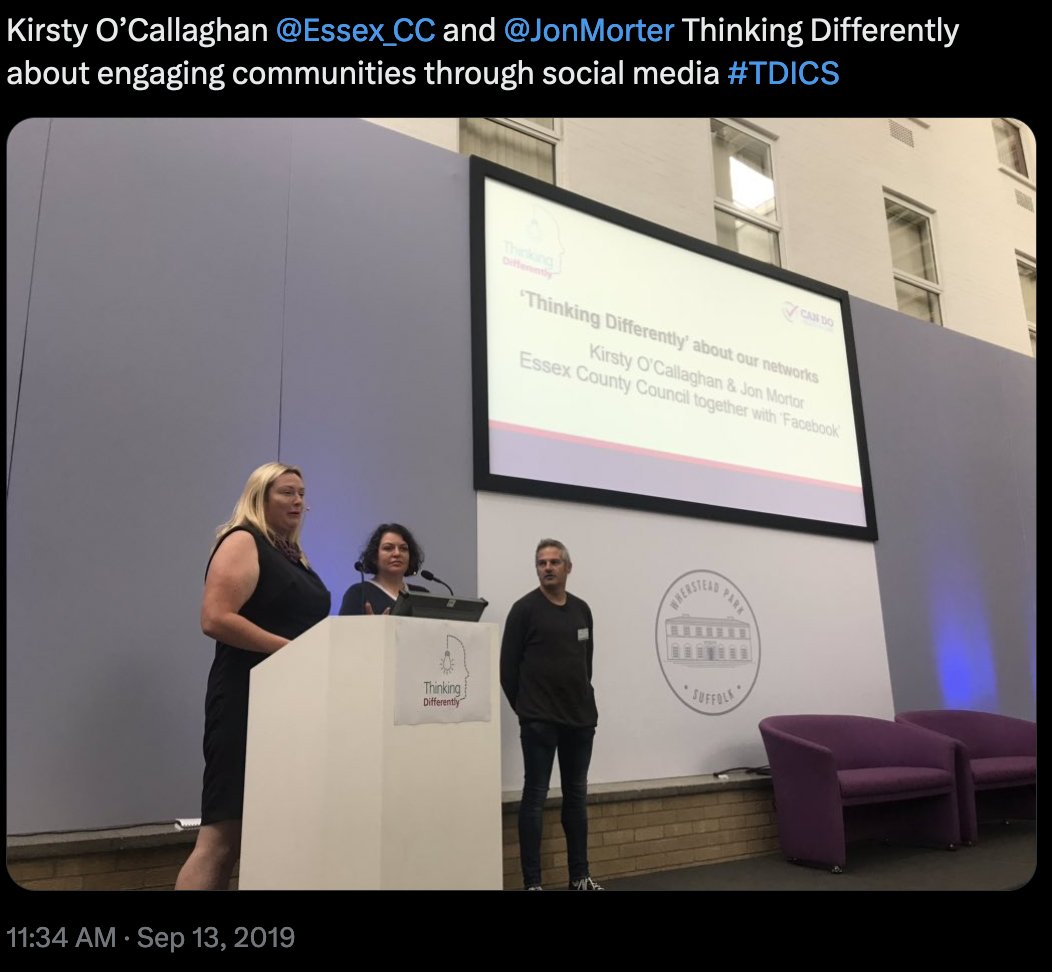
It remains unclear why Simon Harris was chosen to lead the project, although Essex County Council are on record as saying they wished to utilise the services of, and relationships with, “existing contractors” during the pandemic.
Notably, normal procurement and spending rules were abandoned by Essex County Council during the pandemic, which seems to have helped contribute to such a large amount being spent on a single individual. The council's own Audit and Scrutiny committee had a lot to say on the matter—but I'll leave that for a separate article as it doesn't directly relate to Simon Harris. It turns out that the “social media services” were for a series of Facebook pages and associated groups, quite a number of them in fact. The “main” page and group was called Essex is United and was used primarily to communicate “important updates” from Essex County Council that allegedly couldn't reach people if communicated through official channels.
It had 63,000 followers, although relatively low engagement—most posts got “reactions” in the low double digits and comments in the low single figures.
Here are all of the groups connected to Essex is United:
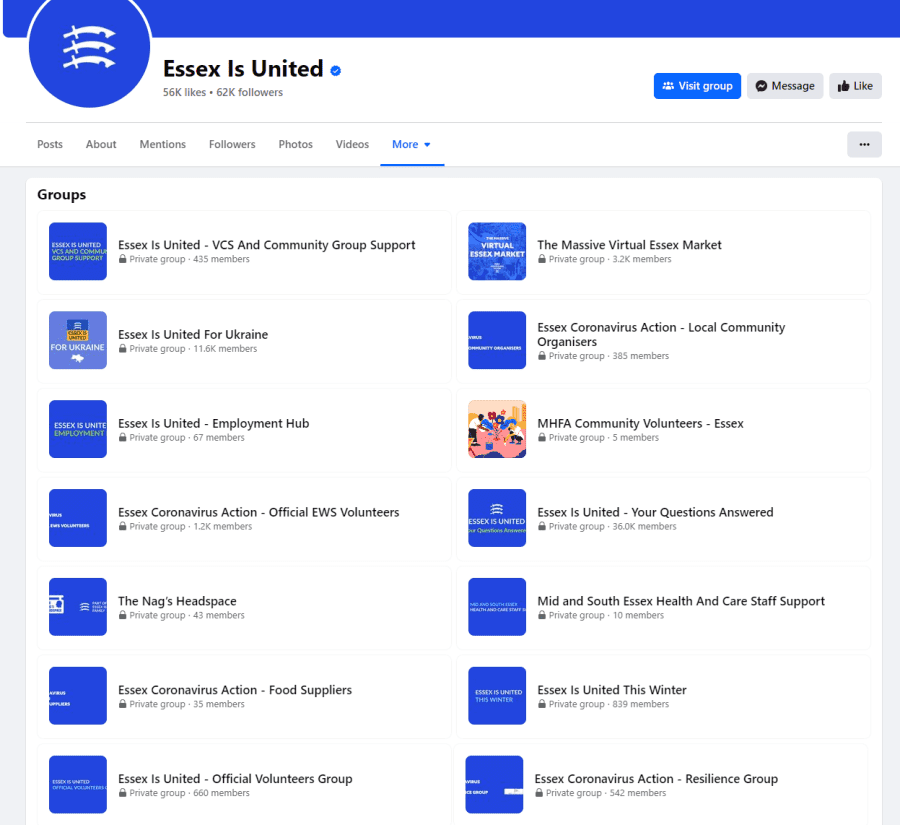
As you can see, membership in these groups was quite low—and the engagement was equally as dire.
There were also “offshoots”, such as the Essex is Green page and associated groups—with 11,000 followers for the page, and membership of 1,251 spread across two private groups.
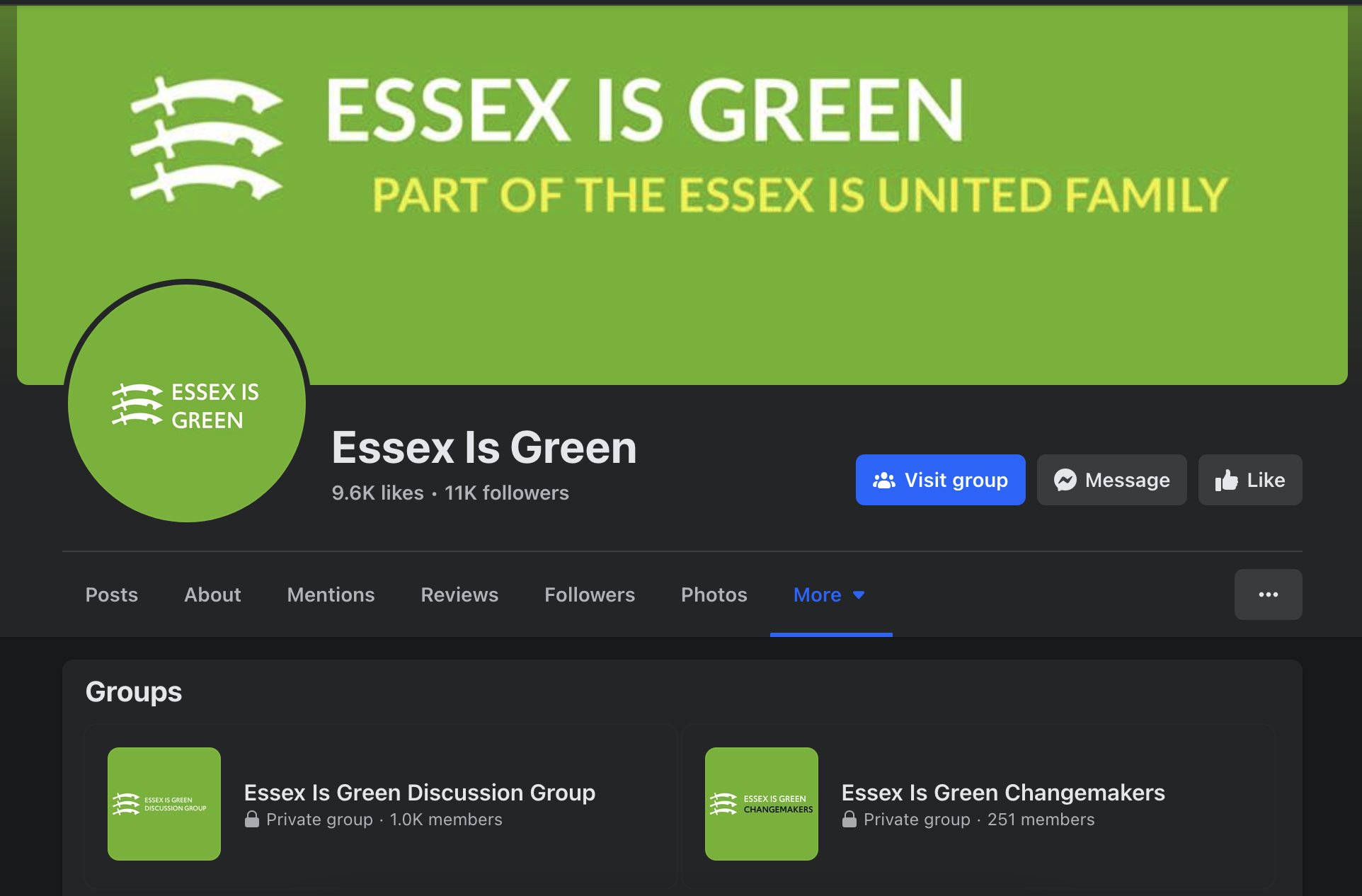
Notably, these pages and groups appeared to mostly cross-post the same messages. For example, a post from Essex is United would typically also be shared across all these other pages and would seemingly artificially boost engagement and other metrics. It's unknown if this “cross-posting” was discounted from the ultimate reporting on how “successful” this project was.
Some of these posts were also widely shared on Simon Harris' own social media accounts, boasting an impressive following themselves. Again, it's unknown if these impressions, etc. were discounted from the ultimate reporting or not.
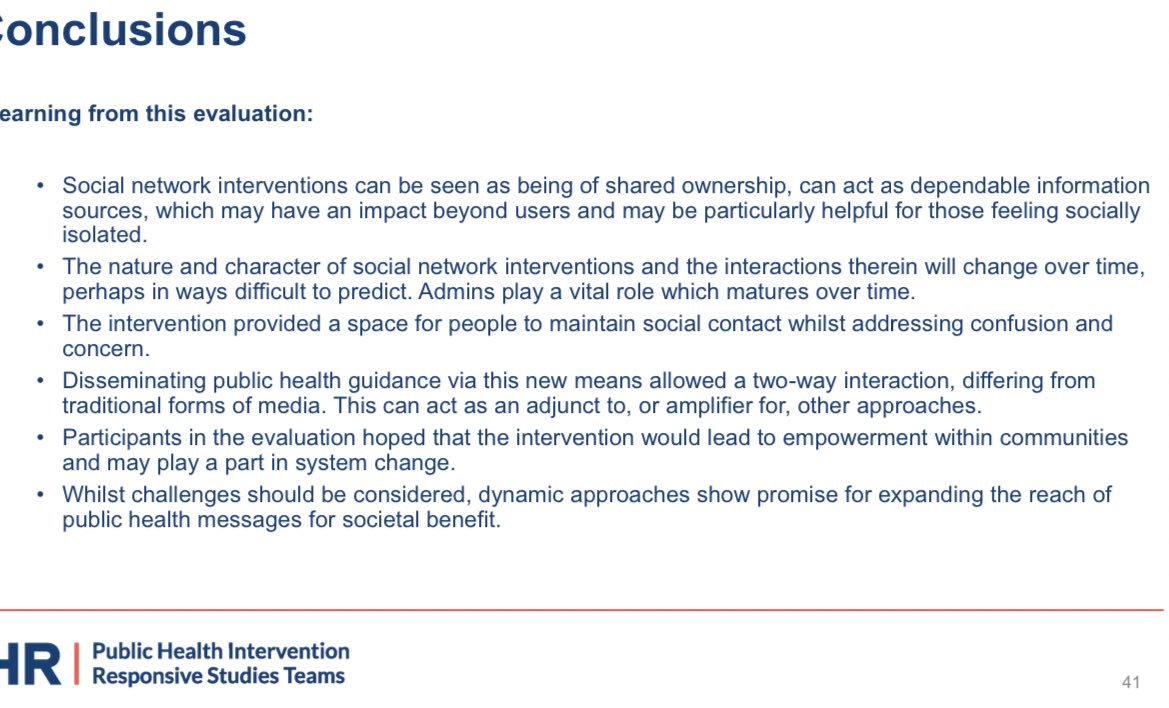
In what appears to have been an tttempt to shore up their position on this, the Public Health Team commissioned an independent, peer-reviewed study from London South Bank University in July 2023.
Here are the conclusions it drew:
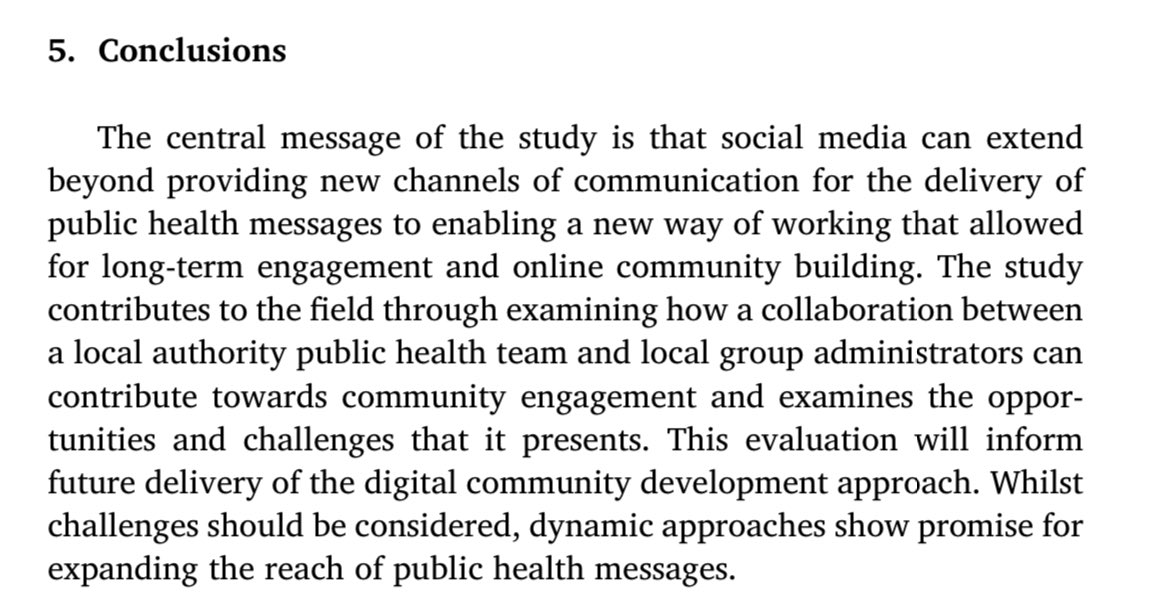
It is not a particularly compelling or persuasive conclusion and while the study originally planned to examine the financial impact of this programme, that was quietly dropped from the original proposal, ending up with the below:
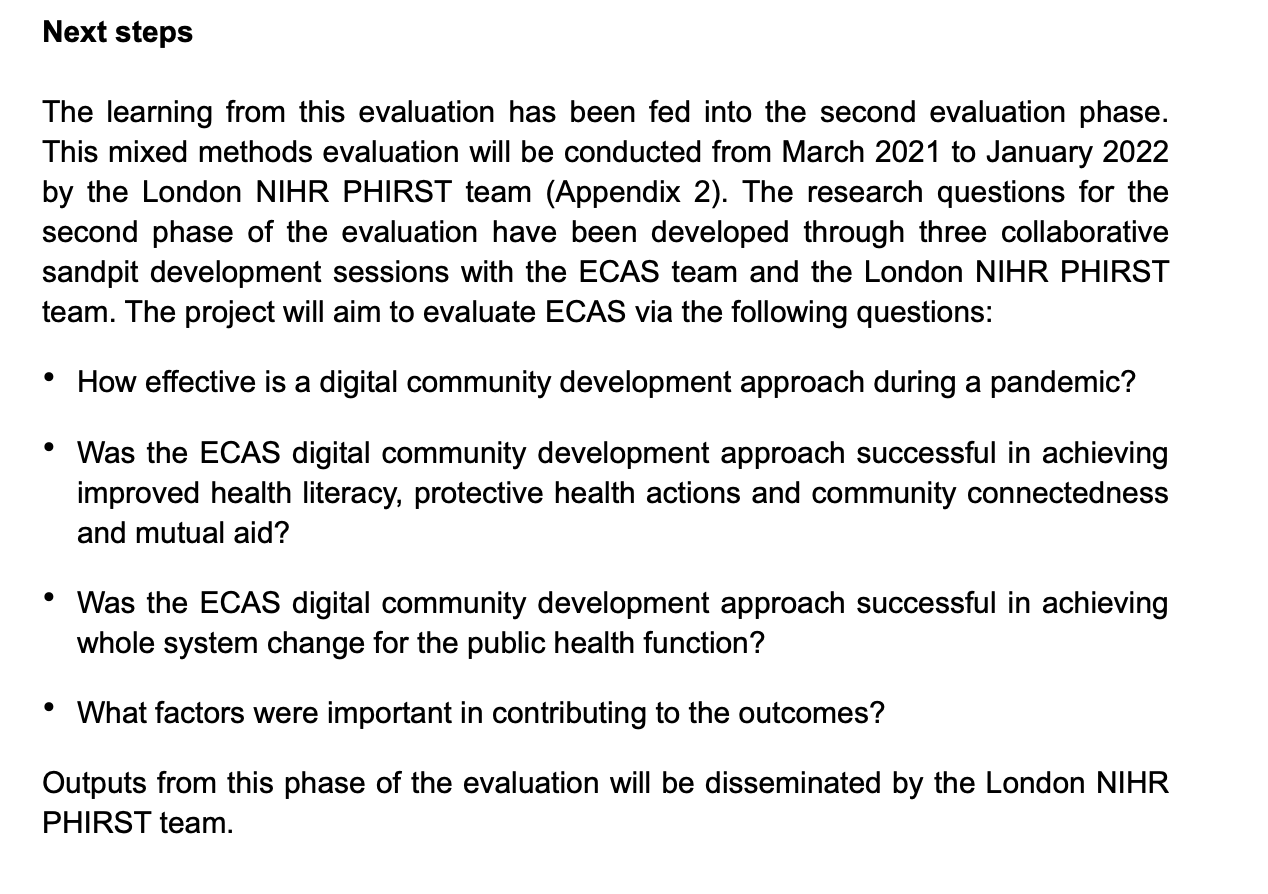
The actual financial analysis was carried out in-house in 2021 by Essex County Council and reported the following:
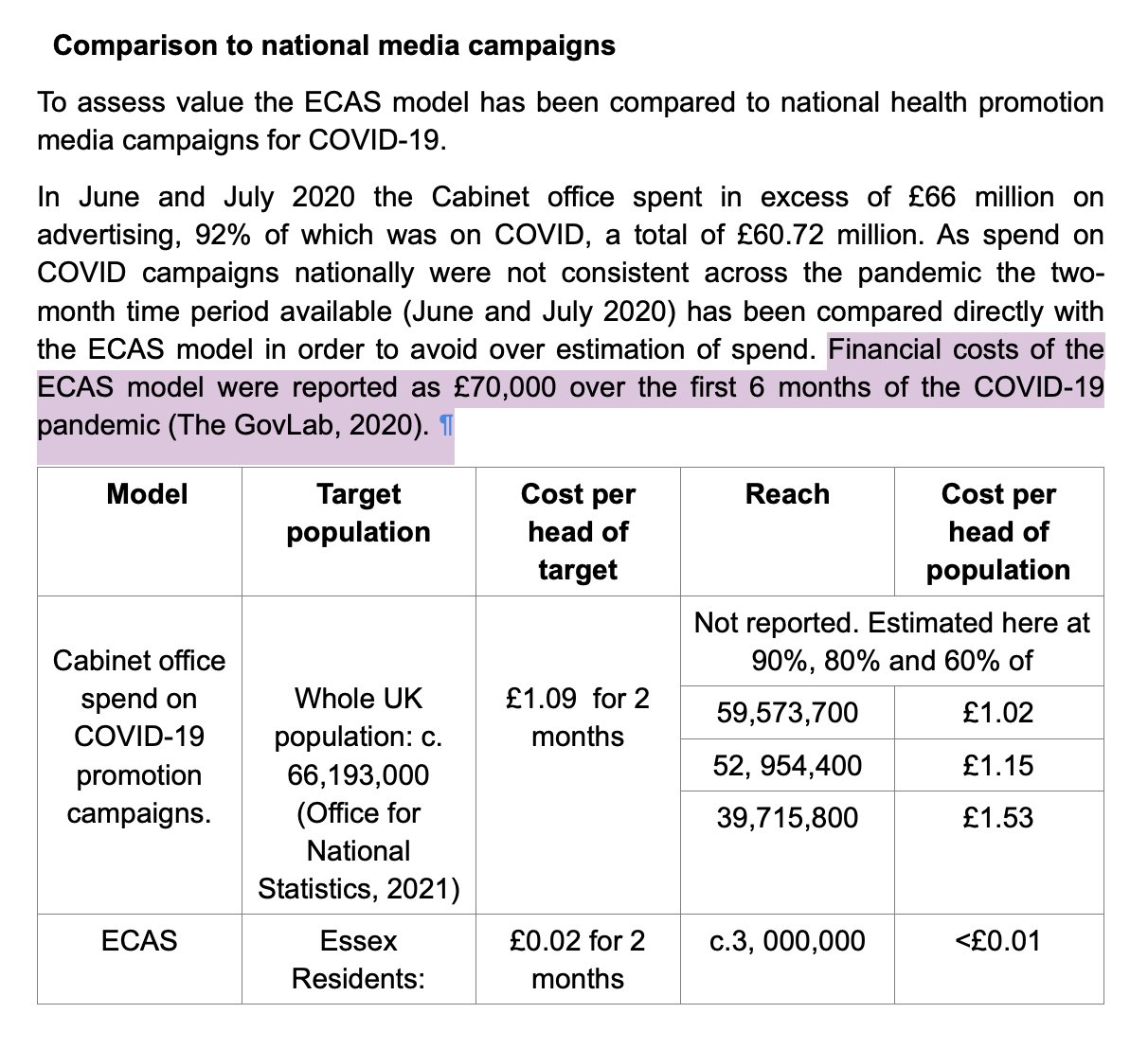
Of course the ECAS figure came with a footnote indicating that this reach exceeded the population of Essex, because the relevant Facebook page was not geographically limited to just residents in Essex, it was available to everyone.
The report then attempted to justify why this whole campaign was necessary:
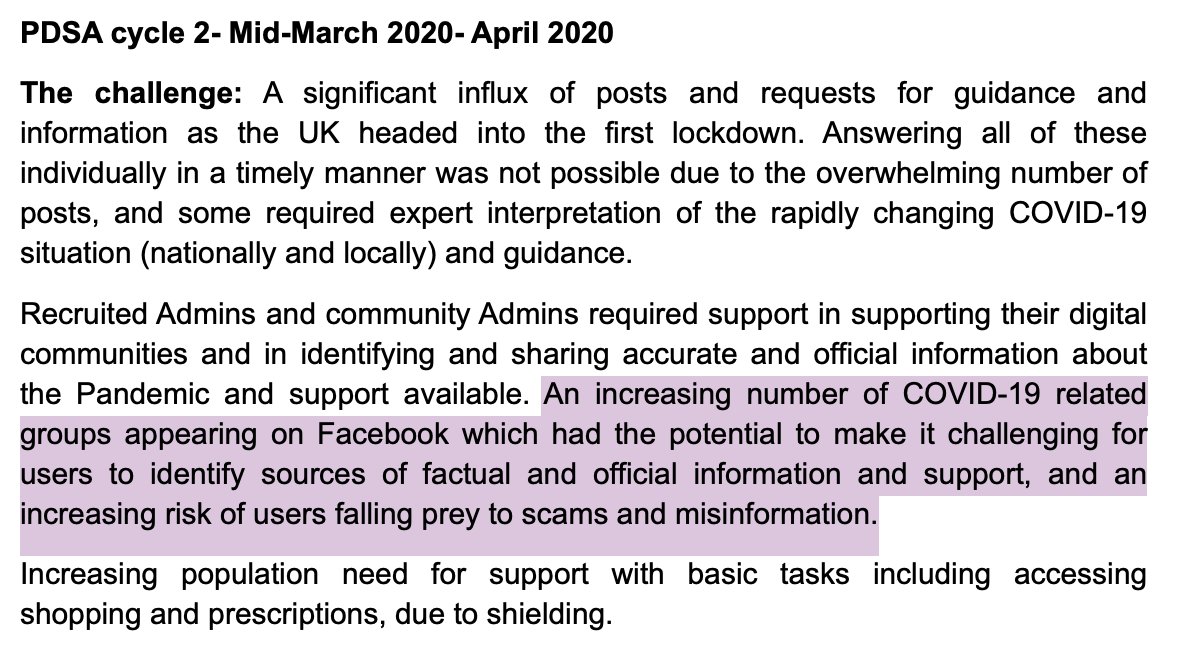
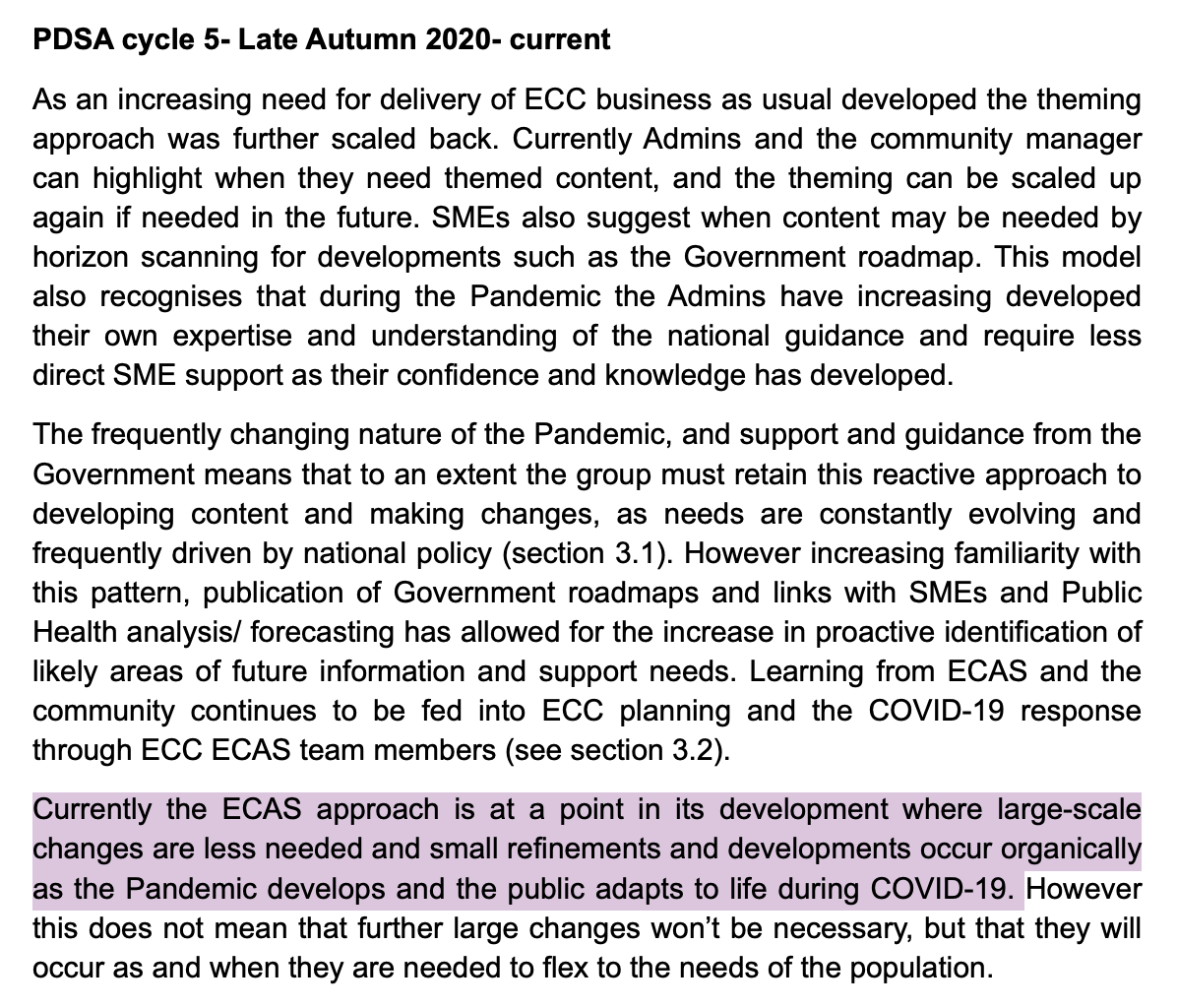
Followed by identifying that as of the time of the report, the model had “matured” and only required small tweaks—effectively suggesting that the “seven days a week, 24 hour” work that Simon Harris has claimed to having been doing was, perhaps, unnecessary.
Both reports were then relied upon by Essex County Council in their statement on the matter given on 10th January 2024, shown below.
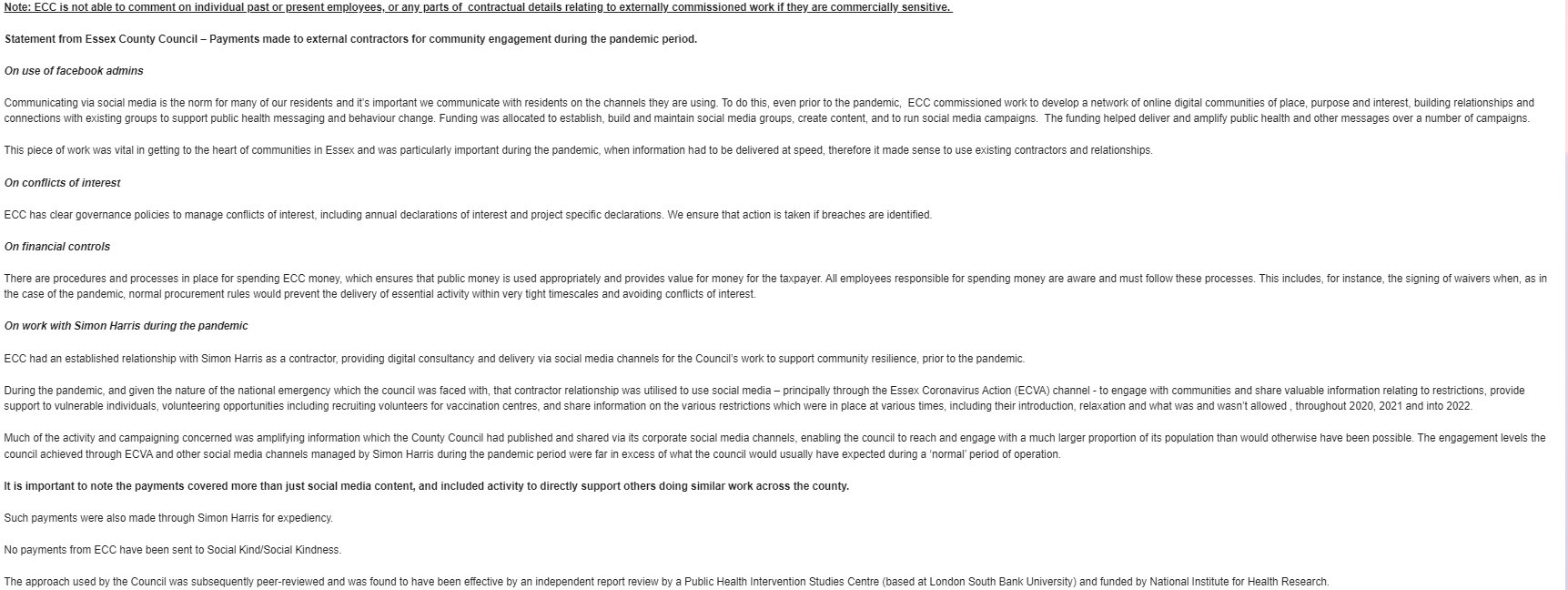
However, there are a number of problems with this statement.
-
They state that this piece of work was vital in getting to the heart of communities. But I would argue that people were already conditioned to receiving information directly from government through official and social media based channels. For example, the vast majority of people would likely have tuned in to see the regular media briefings by Boris Johnson and others. It is logical to assume that they would then look to their local authorities to understand how the rule changes etc. were being implemented and what their local authority was doing. Essex City Council could have capitalised on this by centralising announcements on their existing social media properties. They did not need an entirely separate Facebook page and private(!) groups to achieve this. It would have been straightforward to set up a page on the council website detailing updates, rule changes, etc. and simply had existing, official social media channels point there.
-
The groups are all private. You have to request to join them. What if the group admins take a disliking to you? You are then removed from what is arguably publicly-owned property (yes, I know it's on a proprietary platform but ignore that for now) with no recourse. It is not transparent or democratic to operate a series of publicly-funded closed groups, especially if they are seeking to drive behaviour change and the like. The groups should be open with appropriate moderation implemented.
-
I note they admit that normal procurement procedures were bypassed, including conflict of interest declarations. However, my question is: were these contracts ever re-reviewed, regularised, and subject to the normal process after the pandemic ended? I also note that they don't say that there haven't been any conflicts of interest.
-
They state that Simon Harris' activity allowed the council to reach a far greater proportion of its population than it otherwise would and engagement levels were much higher than anything the council could achieve during "normal" operations. Well yes, of course it would - all anyone was doing was doomscrolling Facebook, anxiously watching the news, trying to understand the myriad announcements and changes around restrictions etc. It's no wonder they reached far more people.
-
What audit processes did ECC implement to ensure that the contractor appropriately disbursed the funds to "directly support others doing similar work across the county"?
-
"No payments from ECC have been sent to Social Kind/Social Kindness." That is a simple matter of fact because it is true, however it does not address the conflict of interest inherent in the relationship between Simon Harris and Kirsty O'Callaghan because she was in a management role as part of the team procuring the services.
-
The peer-reviewed study is, as expected, not as robust as ECC would hope. It effectively takes figures provided by Kirsty, et al. and the conclusion is not particularly assertive. You can read the study and associated slide deck here: https://t.co/mCf94zlX6X and http://t.co/yJfVFqpeH7
-
It appears they use “views” as their metric of success. That is an easily gamed figure and I would expect the service provider to put in place more robust metrics, tracking, etc. rather than "We reached 5 million views on X piece of content". That tells you nothing about what those people (assuming they are not bots) did after that: if they're promoting behaviour change, did those people change their behaviour? You wouldn't have any way of knowing without a robust metrics and tracking system in place.
The statement was delivered 2-3 hours after the 3pm deadline for reply. They had all day to work on it, and this is what they came out with. A mealy-mouthed response that doesn't actually address anything robustly. It merely handwaves the problems away.
That's what Essex taxpayers paid for. £500k, a £32 million budget cut, and a 5% council tax increase for some low-quality Facebook pages created by greedy opportunists during the pandemic panic.
Ultimately, it is difficult to see how any of this justified spending almost £500,000 of public money. The Facebook pages do not appear to have driven the behavioural change and communication of important messages that was desired, there was low engagement, the quality of what was produced seems to be poor value for money, and the bulk of the money ended up being retained by Simon Harris anyway.
There is a lot more to say on the wider programme involving Kirsty O'Callaghan and the Public Health Team, but that will have to be for another article.
Oh, how the mighty fell
Since all of this happened, Simon has reappeared on Facebook. He has not yet attempted to return to Twitter/X, but has chosen to post his usual content on Facebook as well as monetise his brand with Facebook subscriptions, although his audience on Facebook are dramatically fewer in number than the number of followers he used to have on Twitter/X.
It is unlikely to come as a surprise that any comments on his Facebook page and posts that reference the social media payments scandal are swiftly hidden or deleted. Perhaps that is why he prefers Facebook: he can control the conversation in a way that is impossible to achieve on Twitter/X.
He has also been reduced to posting referral links for Octopus Energy at £50/referral underneath every post he makes. There was also seemingly a brief foray into a tea-towel printing business, but it turns out they were not full-sized tea-towels and the business appears to have been quietly shuttered a few months after launching.
Many of his critics have derived a certain sense of schadenfreude from this, and have remarked that it couldn't have happened to a more deserving person.
Time will tell whether the once-mighty Simon Harris will return to Twitter/X or not, but in the words of one critic: “Oh, how the mighty have fallen!” and it certainly seems that way so far.